Chapter 8
Designs in Modern Lace, Part 4
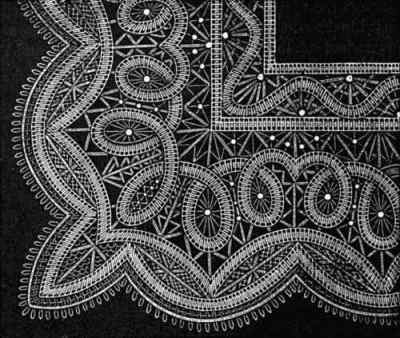
45Corner in Modern Lace
The suggestions given above will also apply to this design, which may be used for a table spread, or a handkerchief, according to the braid selected. As illustrated, the design is of pretty dimensions for a doily or a toilet-cushion cover, or for a handkerchief. All of the bar work seen may be done with single threads instead of the complete Raleigh method, and the rosettes or “spiders” may be larger or smaller as preferred.
No. 45.—Corner in Modern Lace.
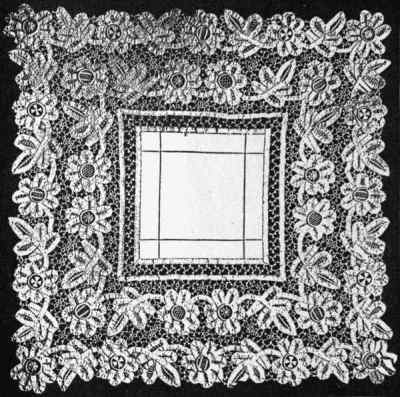
46Pillow-sham of Battenburg Lace and Linen
A very elaborate pillow-sham is here illustrated. It is made of Battenburg braid and appropriate thread, together with an intermingling of rings, and forms one of the most elegant appointments of a handsomely furnished bed-room. The pattern is very distinct and is called the “rose and leaf” design. The ground-work is formed of rings and Raleigh bars, while the centers of the roses and their leaves are filled in in various fancy stitches which include the crosses and rosettes used in drawn-work, Sorrento bars, points de Venise and Bruxelles, d’Alençon bars, etc., etc. If desired the linen square may be made larger, and the lace but one row of blossoms in width. The square is made of the finest household linen and is completed with a broad hem-stitched hem before the lace is added. The lace design may be obtained in any width desired by sending to a professional lace-maker; or, a clever student may be able to enlarge the design herself.
No. 46.—Pillow-Sham of Battenburg Lace and Linen.
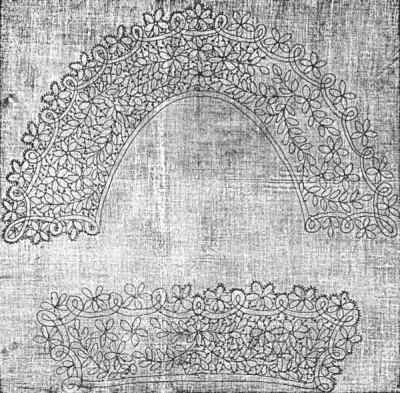
47Design for Princess or Duchesse Lace Collar and Cuffs
Although this design is represented very small, it is sufficiently clear to convey a good idea of its outlines, and enable a student of average ability to adapt it to collar and cuffs of any size desired. Raleigh bars are used in connecting the various portions of the braids, while any of the fine stitches preferred may be chosen to fill in around the loops of the blossoms and foliage. A fine picot braid finishes the edge.
No. 47.—Design for Princess or Duchesse Lace Collar and Cuffs.
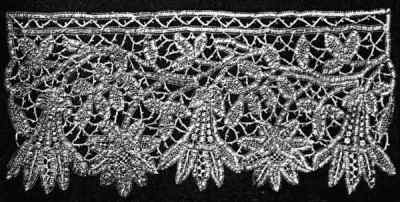
48English Needle-point Lace
This engraving illustrates a very beautiful specimen of modern-point lace in a design combining the lily and the rose. Raleigh bars and buttons render the heavy part of the work effective, while the daintier point stitches and bars are used to fill in the floral sections—coarse and fine thread being used in the work.
This lace, like any of the varieties now fashionable may be made wide or narrow, or fine or coarse by designs furnished as required by lace-makers in general; and the patterns may also be developed in silk or ribbon needle-point, which is a style of ornamentation appearing extensively as a decoration for scarfs, piano and table covers, mantel valences, etc., etc.
No. 48.—English Needle-Point Lace.
49Royal Battenburg Lace
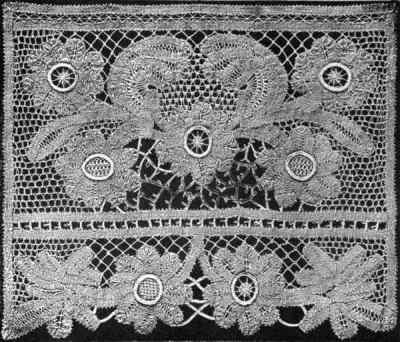
This design was among the first ones of this lace to appear, and is fully entitled to its royal name. Fancy Battenburg braid was selected for the foundation, and various stitches chosen for filling-in purposes. Among the stitches are point de Bruxelles, made similarly to the Italian lace stitch, point de fillet, plain Raleigh bars, point d’Alençon, rosettes, rings and point de Grecque. The central figure conveys a hint of the outlines of the royal crown, and the lace is really sumptuous in design and texture. In 1883, Mrs. Grace McCormick, the originator of the design and lace was awarded a diploma for her work which was forwarded from Washington, where she applied for a patent for her specimens of Royal Battenburg lace, of which this is one.
No. 49.—Royal Battenburg Lace.
50ROMAN LACE (Coral Pattern)
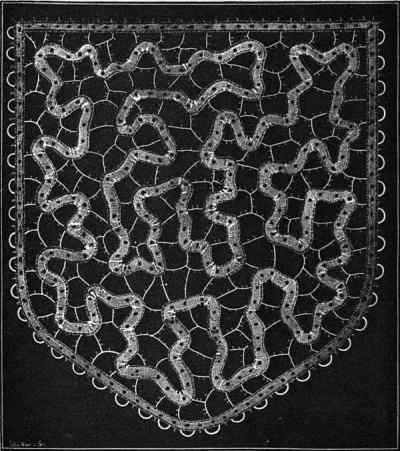
The design here given is for a lappet or scarf-end, and will afford a suggestion for the making of larger articles or edging in similar arrangements of braid. It will be observed that the braid forms irregular lines that recall the branchings of coral, and it will be a very easy matter for an amateur lace-maker to similarly arrange her braid for any purpose she desires. Fine Raleigh bars form the connecting work, and a button-hole picot-finish is made along the edge of the braid which forms the border. In making an edging, a definite outline could be kept for the lower edge, and above this an irregular or indefinite outline arranged.
No. 50.—Roman Lace (Coral Pattern).
51Tidy of Battenburg Lace
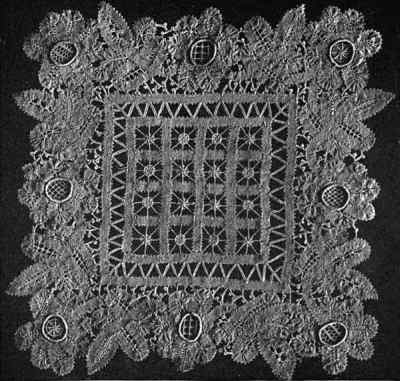
The tidy here illustrated is made entirely of Battenburg lace, and is a beautiful specimen of this kind of work. The border design is the same as the one previously described for a pillow-sham, except that but one row of the blossoms and foliage is used. The center is composed of rows of braid crossed to form squares or open spaces that are filled in with rosettes in point d’Angleterre. This center is attached to the braid at the inner edge of the border by a series of bars arranged in d’Alençon style and then wrought with the thread after the method used in d’Anvers bars. This tidy, enlarged, forms an elegant design for a pillow-sham. When laid over a tinted silk spread or pillow, a sham of this design shows its full beauty. When the braid is basted on in the outlines desired, the remainder of the work will be a pleasing pastime, as none of it is so fine as to require very close attention.
No. 51.—Tidy of Battenburg Lace.
52Modern Lace
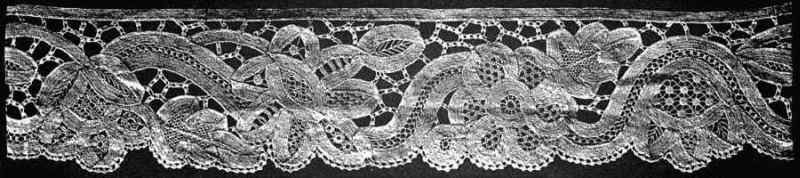
A handsome specimen of lace is here illustrated. It will be observed that the braid from which it is made is woven like fine binding braid, and in this respect differs from any of the lace-braids herein illustrated. It will also be seen that no two figures of the design are alike, and that various stitches are used in completing them, many being combinations of or adaptations from the stitches illustrated at the beginning of this pamphlet. The engraving is sufficiently plain to enable the worker to decide which stitches are used alone or in combination, and to guide her correctly in their application. The picot-edge is done in point de Venise stitch.
No. 52.—Modern Lace.
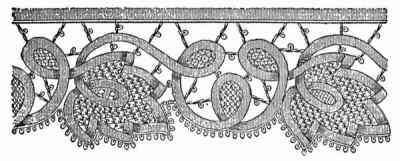
53Modern-point Lace Edging
This is an easy design to follow and is simply made. Heavy Sorrento bars with picot loops form the ground-work, while the filling-in stitches are of the same class done in fine thread in regular squares and also a combination of point de fillet and point de Grecque. A dainty picot-finish is added at the lower edge. This edging is pretty for bordering draperies or decorating dresses, and may be made as fine or as coarse as desired.
No. 53.—Modern-Point Lace Edging.
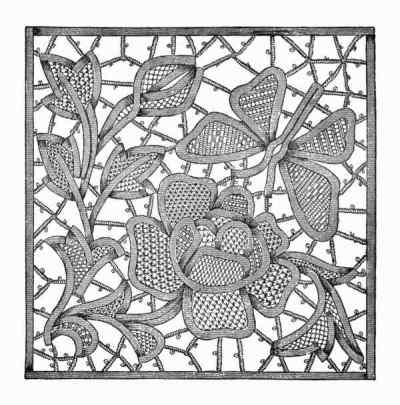
54Square in Modern-point Lace
In this design will be observed a favorite combination—the rose and the butterfly. Close inspection will also disclose that the filling-in stitches are of a diverse character, and that to this diversification much of the beauty of the work is due. As most of the stitches are easily recognized, and as the copyist can easily adapt methods for the combinations seen, it will not be necessary to definitely describe them.
The square may be used for a scarf-end in connection with the edging No. 53 seen on page 91, if the braid selected is sufficiently fine. When coarser braid is chosen, the square will be pretty for doilies, tidies or the center of a table spread. The design may be daintily made up of ribbon, with silk for the stitches. In this event it may be set into a scarf or drapery of China or Surah silk with charming results.
No. 54.—Square in Modern-Point Lace.
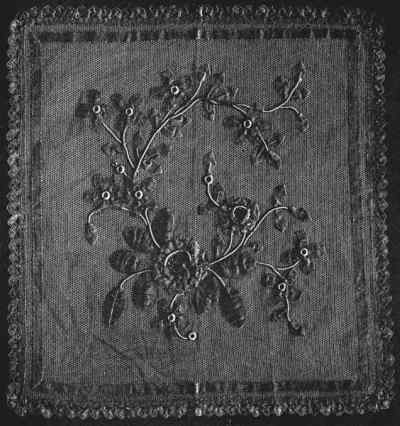
55Louis XIV. Curtain-lace
This is a very popular decoration for curtains and vestibule doors and is made of heavy écru or white net and braid. The design selected is generally a border with a corner piece, and sometimes a center piece. The specimen here given is simply a square of the net decorated as illustrated to convey an idea of this at present fashionable curtain lace. The design is first traced on tracing cloth that is then underlaid with brown paper to hold it stiffly in place. The net is then laid over this and smoothly basted down so that the tracing shows through plainly. Then écru or white Battenburg braid is used to follow the design, and is shaped into the leaves and flowers seen, rings being used for the centers of the blossoms and écru or white cord for the stems. The net is cut from under the rings at the centers of the large roses, and each opening is filled in with point de fillet and English wheels. The effect is very rich and the work is not difficult to do.
When a curtain is thus embroidered or decorated with braid, it is bordered the same as the square illustrated, or upon that principle, with rows and points of Battenburg braid. Ribbon is often used in this way for tidies, bureau scarfs and various other little household decorations, and in this event the flower and foliage tints may be carried out in the design.
No. 55.—Louis XIV. Curtain-Lace.
Reprinted from The Art of Modern Lace-Making (The Butterick Publishing Co., 1891). Free for personal use. Please share a link rather than copying this page.