Chapter 2
The Plates: Forms and Fillings
Op. I: Tudor Work

Plate 1
This plate was sketched from a very old strip of Tudor work, measuring about 5ft. 8in. in length and 1ft. 8in. in width. Each leaf was about 22in. long and 19in. across. The strip had evidently been part of a bed valance, and, as far as one could tell—for it was much faded—had been worked in two shades of wool only—dark indigo blue and bright green; the latter had faded, almost everywhere, to a soft mignonette colour.
Op. II: Early 17th Century
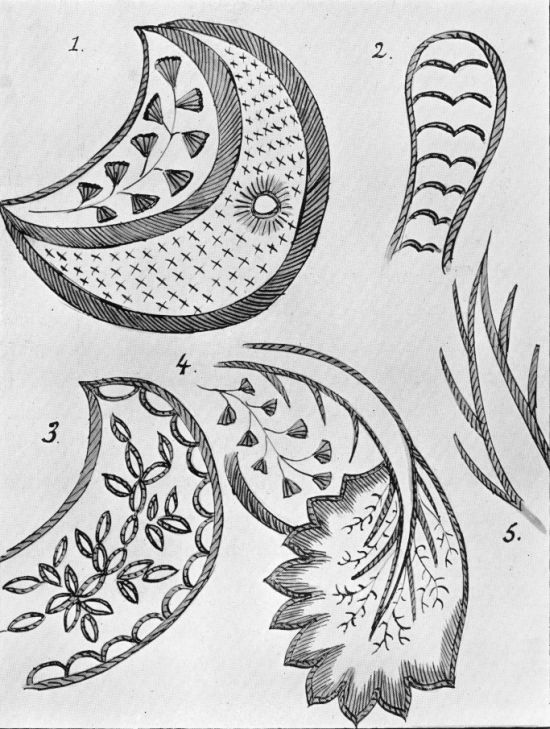
Plate 2
- A group of blue leaves, etc., taken from some old cushions at Knole Park, Sevenoaks.
- No. 1. Stem stitch contour: Maidenhair in buttonhole stitch. Star in buttonhole stitch on background of small crosses.
- No. 2. Stem stitch.
- No. 3. Stem stitch contours. Centre in loop stitch.
- No. 4. Stem stitch contours. Centre loop stitch and maidenhair in buttonhole stitch.
- No. 5. Stem stitch.
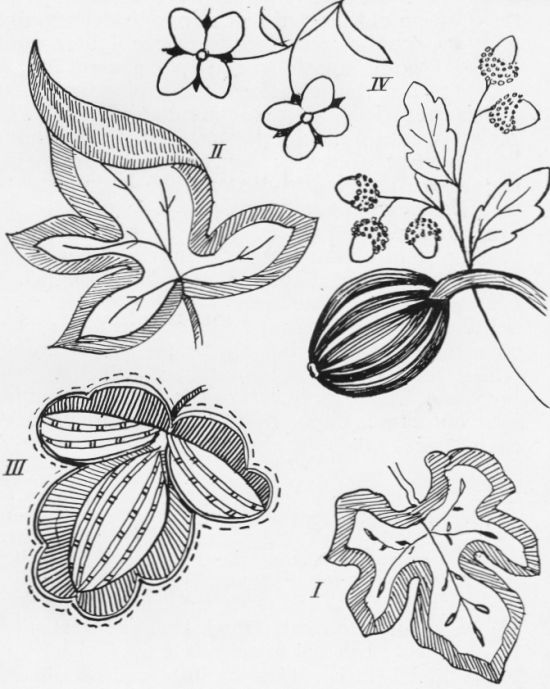
Plate 2 a
- GROUP of the lighter details that break up the heavy masses in the earliest and latest examples.
- The medlar-like fruit is worked in Crewel stitch in bands of brown, stem lighter in shade.
- The leaves, Example I & II, satin stitch with stem stitch outline both sides, centre veinings in stem stitch, turnover in leaf, II, in block stitch.
- III Buttonhole edging with darned centre, centre filled with strands of wool caught down at intervals with double back stitch.
- IV Flowers in soft blues in satin stitch, acorns have their cups worked in French knots.
Op. III: Details of Blue Crewel Work (the late Lady Maria Ponsonby’s)
THE following plates were sketched from an old strip of work done in deep indigo worsted wool, with a rather lighter wool, both in colour and make, used in the fine buttonhole work and darning, of which there is much throughout the work. The design was a branching one, the flowers and leaves—most of which appear in the following plates—are hanging from stems about a quarter of an inch thick done in herring-bone stitch, with the exception of the violas (plate 5) which have a thicker stem of their own in herring-bone, stem stitch and loops. The thistles (plate 3, No. 1) reproduced the same size as in the work, were scattered about in groups of three, making a very pleasing contrast to the hanging roses (plate 6), whilst the irises reared their heads all along the bottom of the strip, but owing to the work having been cut, it was impossible to see how they joined their straight stalks to the branching ones above.

Plate 3
- No. 1. Stem stitch contour: diaper work done in coral stitch, with a French knot filling in each alternate square. Four rows of buttonhole stitch at top of flower.
- No. 2. Stem-stitch, coral stitch and darning.
- No. 3. Buttonhole stitch, French knot and stem stitch.
- No. 4. Stem stitch and buttonhole stitch.
- No. 5. Coral stitch. (These tendrils occurred all over the work and were very effective.)
- No. 6. Buttonhole stitch: centre and stalk in stem stitch.
- No. 7. Stem stitch and loops.
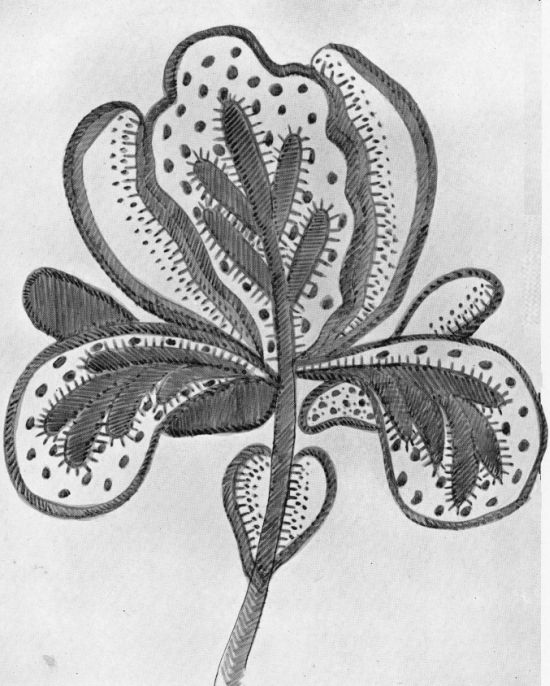
Plate 4
THE iris shown here was worked as follows: The contours in stem stitch throughout. The centre and two side petals have stem stitch veins, edged buttonhole stitch and were filled in with big knots. The smaller petals were partially filled in with buttonhole stitch and darning. The dark petal on left was done in Cretan[3] stitch edged stem stitch.
[3] A variation of herring bone stitch.

Plate 5
- No. 1. Contour in stem stitch, filled in lightly with buttonhole stitch, and darning and long-and-short stitch.
- No. 2. Ditto, with the addition of herring-bone stitch on two upper petals.
- No. 3. (Stalk) herring-bone stem stitch with loops between.

Plate 6
- No. 1. Stem-stitch, buttonhole stitch and darning.
- No. 2. Ditto.
- No. 3. Stem stitch, buttonhole stitch, French knots and darning.
- No. 4. Stem stitch, buttonhole stitch and darning.
- All have herring-bone stitch stalks.
- Sketched from a piece of work in blue crewels on white linen, belonged to the late Lady Maria Ponsonby.
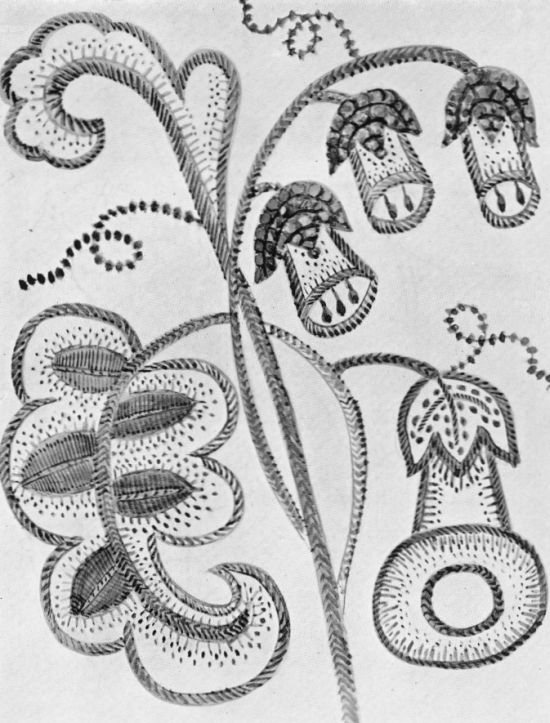
Plate 7
MOST of the stitchery shown here is similar to that on the preceding plates, but has the addition of the plait stitch[4] edged with buttonhole stitch in the veins of the big leaf, and the close knots on the sheaf of the foxgloves, while the sheaf of the convolvulus has veins of stem stitch and small French knots.
In all this piece of work there is to be noted a great deal of buttonholing and darning.
[4] A variation of herring-bone stitch.
Op. IV: The uses of Stem Stitch and other characteristics
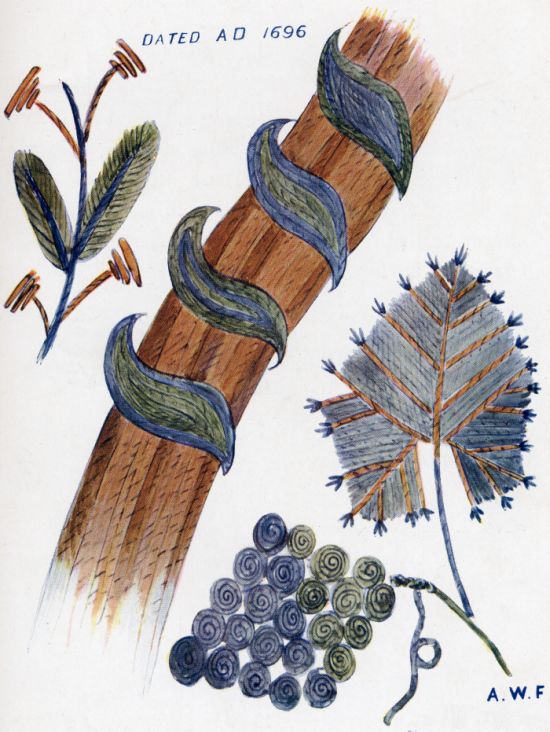
Plate 8
SHOWS many uses to which stem stitch can be put, which is the only stitch employed in the work illustrated here, if we except the little arrow-heads used to edge the vine leaf.
THE following sketches were taken from a most beautiful and elaborate strip of work, forming part of some bed-hangings, dated A.D. 1696, worked in hard twisted crewels in blue, mignonette, and green colourings only.

Plate 9
- treats of button-holeing stitch done in a variety of ways.
- No. 1 has groups of three button-hole stitches and crosses in centre, and is edged by chain stitch and arrow-heads.
- No. 2. Button-hole stitch centre and edge.
- No. 3. Button-hole stitch with stalks in stem stitch.

Plate 10
IN this sketch are three principal stitches, viz.: Chain stitch filling in spaces Nos. 1-2 (on left of sketch) and forming the contour of the whole leaf; button-hole stitch filling spaces Nos. 3-4; and a lace stitch filling spaces Nos. 5-6-7. The other two spaces are filled by brick stitch, and darning with little veins of coral stitch and herring bone. There are loop stitches in the centre of the veining in spaces 6-7, and these are also worked round the outside of the leaf.

Plate 10a
THIS leaf, having a contour of chain stitch, is filled in at the top with a brown and blue branch in stem stitch, edged with short-and-long stitch. The green turnover is in chain stitch with blue chain stitch veins, and the blue turnovers at base of leaf are done in a lace surface stitch, while the rest is filled in with small darning stitches, coral stitches and a little bit of button-hole stitching. The three central leaves crossing stem are in red and green, and blue and green; the brown stalks are worked in stem stitch. Loops are worked round the outside of the leaf here as in all the bigger leaves on this work. The spike on the left of the sketch is in herring bone stitch edged with arrow heads.
Op. V: Bed Hangings at Hardwicke Hall
THE following three plates are sketches from the bed hangings in the “Chapel” room at Hardwicke Hall, Derbyshire—the property of the Duke of Devonshire.

Plate 11
Shows the full design, which is a repeating one, of the hangings. The details of the stitchery will be found on the following plates.
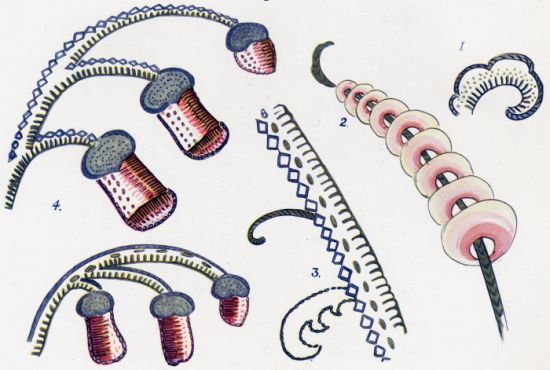
Plate 12
- No. 1. One of the many conventional foliations in this design, carried out in stem stitch, buttonhole and darning.
- No. 2. Close chain stitch for the circles with herring bone for the stalk running through them.
- No. 3. The same stem as in foxgloves but with darning introduced up the centre.
- No. 4. The sheafs of the foxgloves are worked in crochet stitch edged stem stitch.
- The contours of flowers in back stitch, filled in short-and-long stitches and darning.
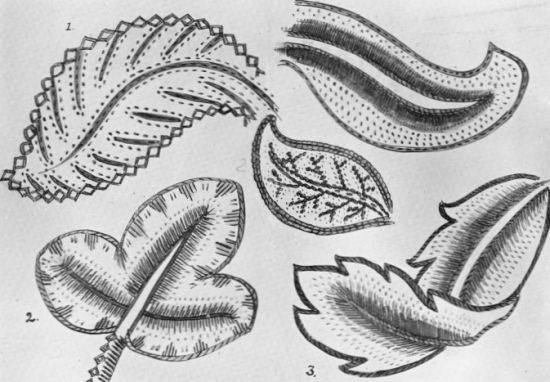
Plate 13
- No. 1. Contour in chain stitch. Vein stem stitch edged two rows short-and-long stitches and darning.
- No. 2. Contour in double chain stitch. Veins in knot stitch edged darning. Loops in middle of centre vein.
- No. 3. Contour in stem stitch; vein ditto, edged with two rows of short-and-long stitches and darning.
- No. 4. Contour in chain stitch, edged darning. Centre vein chain stitch. Branching veins knot stitch outlined with darning stitches.
- No. 5. Contour buttonhole stitch and darning. Veins knot stitch and darning.
Op. Va: Groups of Fillings in which darning plays important part

Plate 14
A group of fillings in which darning plays an important part, the backgrounds of two of the leaves were carried out in indigo, the veinings were worked in solid rows of outline stitch in brown shading to a lighter bronze green, the central vein in the upper leaf was in chain-stitch in dark blue and the outline of leaf was carried out in two rows of chain stitching in darkest indigo. The shamrock leaf has a darned contour of double threads, the filling was in stem stitch, solid, with bars of a darker colour worked across it. The little band at the bottom of the group was a mixture of satin, chain, stem and French knots.
Op. VI: Bed Hanging from Powis Castle
The following sketch was done from bed hangings, the property of the Earl of Powis, at Powis Castle.

Plate 15
THE design is a bold one of big leaves worked on the usual thick white hand-made linen. Undoubtedly the wools used were green at the time of working, but have now changed to beautiful shades of blue to indigo. Each leaf throughout the work has a thick contour in rope stitch of the four shades of the wool used, and the stem is most effective, done in squares of Cretan stitch in the same four shades.
Op. VII: Characteristic Foliations and Late 17th Century Fillings
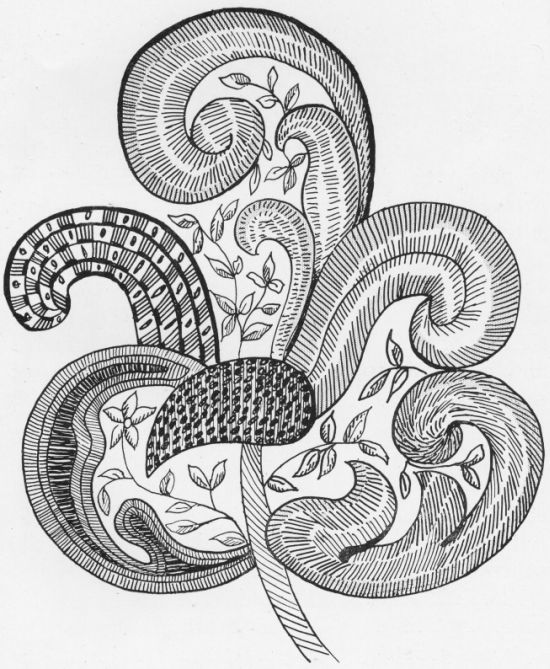
Plate 16
THIS bold leaf is mainly carried out in block shading, but the colours are unusual. Indigo for the outside edge, soft brown the central block, and light green for the inner; in the second leaf the green is employed only for the line of veining; the two leaves or sections on the right-hand side are treated as follows—The upper one has outlines of brown, between which blocks of “buttonhole” in indigo are worked, the intervening spaces being simply decorated by a loop stitch in green wool. The sprays are in satin stitch, which is one of the best for small sprays to be worked solid.
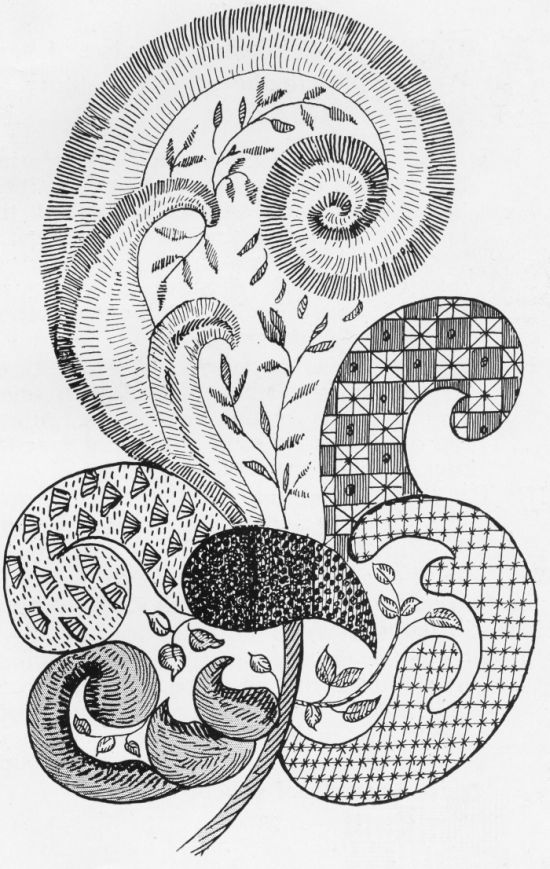
Plate 17
A very handsome leaf, in the working of which many stitches are employed.
The curved scroll at the top is carried out in block shading in blue to pale green; the curved section on the right is marked out in squares filled alternately with satin stitches, with a simple French knot in each square, and by a square trellis secured in the centre by a cross stitch; the scroll below this is outlined in crewel stitch, and filled with laid work or strands of wool thrown across from edge to edge and couched by back stitches at the points of intersection.
The three leaves at the root of the stem are carried out in block shading in shades of grey green, the leaf above is outlined in crewel stitch and filled with fancy devices worked in buttonhole stitch with darning background; the centre motive is a solid mass of French knots, well raised and blue in colour. I have seen this same motive carried out in three shades, the lightest group at the point, the darkest at the back.

Plate 18
MORE fillings taken from a piece of work executed in the late 17th century.
I Is one of the diverse methods of treating the large tree stems in a design. Within the fan-like outlines traced down on the linen is a solid filling of satin stitches, varying row by row from pale fawn at the foot to dark chestnut brown round the top, the direction of the stitches is shewn in the drawing.
- II Here we have a fancy lattice of three strands of laid wool couched with small French knots at the intersecting points, the outline is in stem stitch and fanciful back stitches are used as fillings.
- III Has first rows of long single threads thrown across, caught down with stars and groups of satin stitching crossed.
- IV A light treatment for stems, the filling, shells in buttonhole stitches, with second outline in darning.
- V One of the examples of the introduction of lace stitches that is to be noted in work of the late 17th century, the alternate blocks are in basket stitch, the others in double cross stitch in contrasting colours.
- VI Quaint example of couched work.

Plate 19
- A collection of particularly beautiful fillings seen in a Georgian copy of a very old example.
- I Has double rows of outline stitch, framing spaces filled with stars in back stitch, the centre being solid in shading stitch.
- II Outline of rope stitch and cross trellis of the same. Stars of back stitch couched down with contrasting wools.
- III Part of a beautiful stem, outline of chain bars of button stitch in double wool and spots in loop stitch.
- IV The two small petals filled solid with stem stitch, three rows of which are used for outlining the long petal, the centre being filled with rings in buttonhole stitch and darned background.
- V Is carried out in satin and stem stitch, with back stitch bars couched with contrasting wool.
Op. VIII: Solid Crewel Work 18th Century including the Terra Firma and different birds and beasts

Plate 20
THESE two sketches were taken from an 18th century (?) curtain done in solid crewel work, in somewhat bright colouring. The brown veining which occurs in I and in nearly all the leaves was most effective; in this plate is also shown a good example of basket stitch stem work. The acorn cup was worked in close French knots.
II The large leaf is a good example of solid work. The contour was in stem stitch, the serrated edges turned over on to the brown surface were in shading stitch, the red veinings in satin stitch.
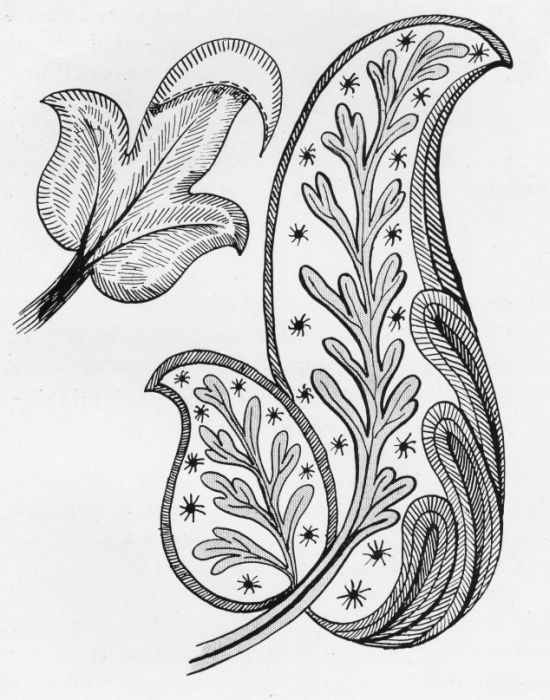
Plate 21
THESE two leaves are of a bold, simple character that is easy to suggest, and proves a great relief in a design that is somewhat over-detailed. The large one is carried out in browns and greens. The turned over serrated edge is in satin stitch of graduating shade. The heavy veining is somewhat unusual in that it is carried out in laid stitch, dark green in the centre and light green outside. The stars are worked in dark green. The outline to the lower leaf is in two shades of green, the palest continuing to outline the remainder of the large leaf.
The small leaf is worked solid in shading stitch in blue with brown satin stitch edge, the veining is brown as is also the contour of the upper point.

Plate 22
WE have here a large leaf very characteristic of the complicated detail introduced by the conventional treatment of foliage in early English work.
The curved point of the leaf is outlined in rope stitch in a dark shade of soft bronze green, the heavy double cross lines are in crewel stitch and of a lighter shade of bronze in which the square lattice is also carried out, the French knots in the centres are of a dark olive green.
The round medallion is outlined similarly to the above but in darker shade, the centre being worked solid in slanting satin stitches set in rows, each row taken at the opposite angle to its neighbour; the next leaf is outlined inside, in two rows of chain, the turnover of the leaf being solid satin stitch in three shades of green. The stem is double back stitch, and the other leaves are worked solid in shading stitch in graduated shades of green.
The two small leaves, I & II example: 1st, rope stitch with alternate fillings of darning and outline stitch, and 2nd, rows of outline stitch for one-half the back leaves and one-half grey knot stitch and blue snail trail in alternative, the end leaf being in rows of outline of brown colour.
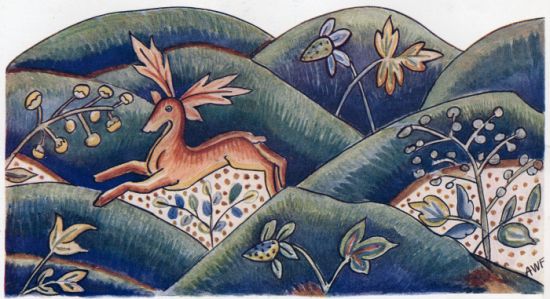
Plate 23
- A portion of the terra firma of the curtain.
- The strawberries and clear parts of the ground are worked in French knots.
- The plants are very useful in breaking up the solid masses of dark colour, and the stag serves to introduce into the base of the work the colouring of the acorns above (on plates 1 and 2).
- As a rule this base of a design repeats all the colourings used throughout.

Plate 24
EXAMPLE of a bird introduced into the late 17th century work.
It is executed in simple feather stitch for the tail feathers and satin stitch very evenly shaded. The dark centres of the short feathers are in crimson, the rest in shades of buff, the breast feathers also worked in satin stitch are in putty colour, legs and beak are brown and the crest in crimson.

Plate 25
QUAINT early example of a parrot, head in knot stitch, breast feathers block stitch, and wings in shaded single feather stitching.
The butterfly and grub are found in all early examples.
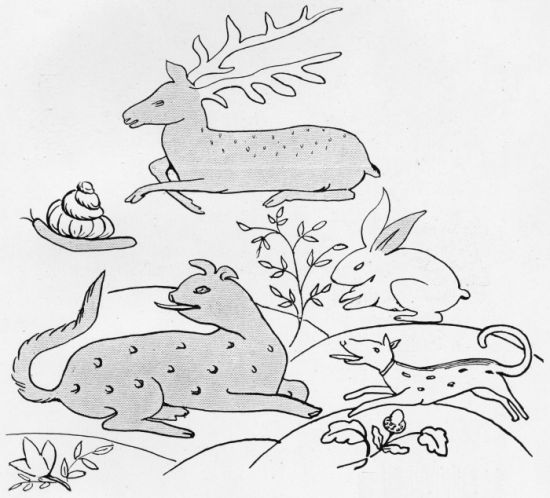
Plate 26
GROUP of animals usually disporting on the terra-firma at base of large designs.
Worked always in long and short stitch.
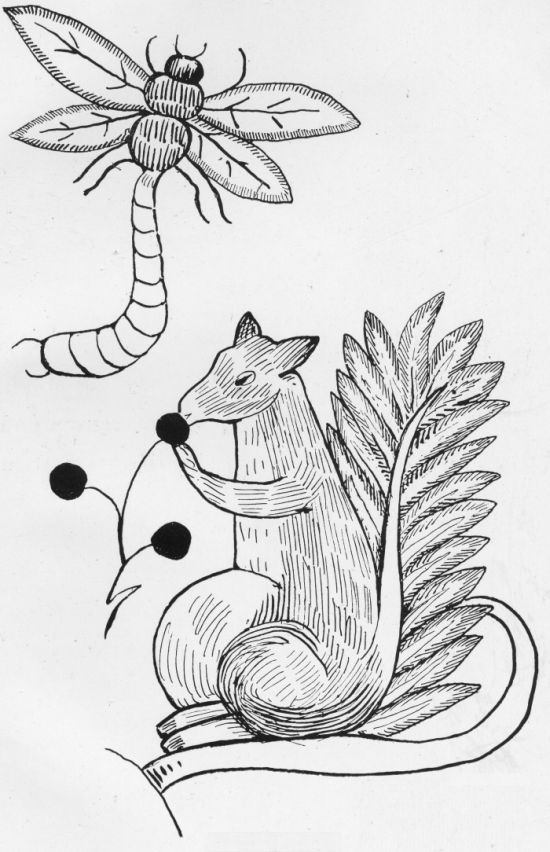
Plate 27
SQUIRREL in rich brown colour, with cream chest worked in shading stitch, tail in overcasting for the centre and furry part in single feather stitch with stem stitch outline.
Reprinted from Jacobean Embroidery: Its Forms and Fillings, by Ada Wentworth Fitzwilliam and A. F. Morris Hands (1912). Free for personal use. Please share a link rather than copying this page.