Chapter 7
Designs in Modern Lace, Part 3
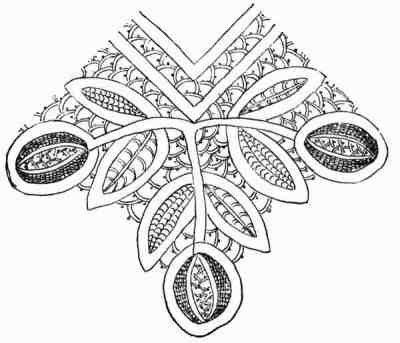
27Apple Design for a Corner in Battenburg Lace
This design is for the corner of a scarf, spread, tidy or pillow-sham and is very popular, as it is effective though simply made. The fine stitches are point de Bruxelles, while the others are Raleigh, Sorrento and point Grecque bars. Plain or fancy braid, or a combination of both may be used in this design with a charming effect.
No. 27.—Apple Design for a Corner in Battenburg Lace.
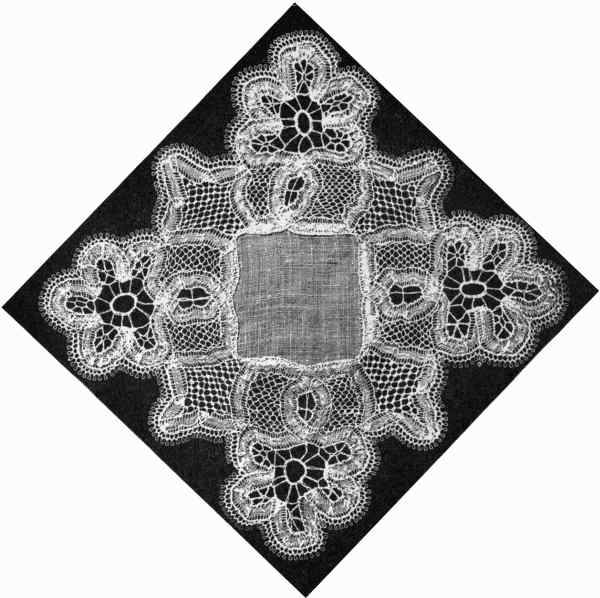
28Roman Punch-glass Doily in Point Lace
Doilies of this description are generally made about four inches square. The engraving opposite pictures the doily mentioned as somewhat smaller, but the design is sufficiently large to enable the student to make her doilies as large as she desires them to be, as it is easy to follow. The corner spaces are filled in with twisted bars and rings worked at the same time; but rosettes or spiders may be worked in place of the rings if preferred. The corner spaces are filled in in point Brabançon, and for those at each side point de Bruxelles is used. The doily is edged with a fine picot-braid that finishes it daintily, and very sheer linen lawn is used for the center.
No. 28.—Roman Punch-Glass Doily in Point Lace.
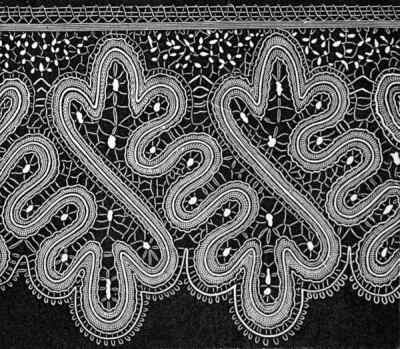
29Modern Russian Lace
The design illustrated may be followed in Battenburg braid or plain lace tape, and any of the fancy stitches mentioned and described among the rosettes, bars and picots may be employed for filling-in purposes. Cream white or unbleached braids or tapes are prettier for Russian lace than pure white. Russian lace is a very durable as well as effective trimming for household draperies, and also for gowns of wash fabrics or those of cotton fabrics which will not need renovating.
No. 29.—Modern Russian Lace.
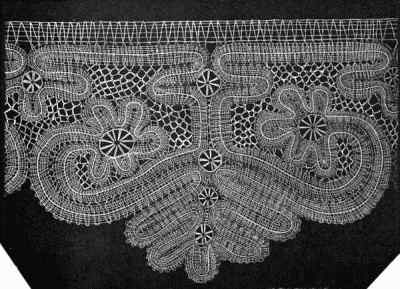
30Russian Lace
This engraving represents a specimen of genuine Russian lace made of fine braid, and wrought with bars similar to Raleigh bars, except that they have no picots. The Russians have always been noted for their exquisite needle-work, but as a nation they have never had any established lace manufactory. The workers of the small amount of lace produced are scattered about at their own houses, and many of them are poor ladies of gentle birth. Most of the laces, however, are made by the peasantry, who bring them to St. Petersburg where sale for them is found.
No. 30.—Russian Lace.
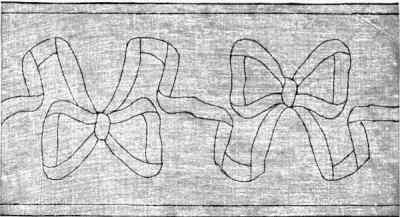
31Bow-knot Design for Modern Lace
This fashionable design may be developed in various widths and braids as an insertion, or as an appliqué on lawn. The ground-work may be formed of Raleigh bars, or of twisted bars made like the net-work for Raleigh bars. The loops of the bows may be filled in with point de Bruxelles or any fine stitch preferred. The design is pretty for bordering table scarfs, tidies, valances and curtains when heavy braids are selected. The finer braids render the design appropriate for handkerchiefs and dainty trimming laces.
No. 31.—Bow-Knot Design for Modern Lace.
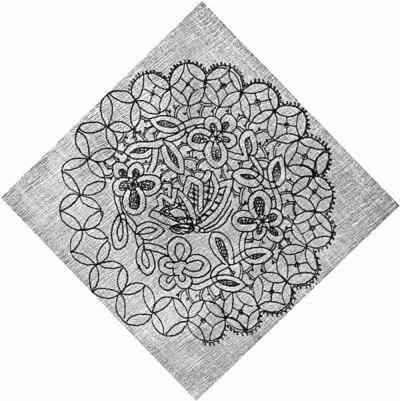
32Princess Lace Doily Design
The design here illustrated may be enlarged or simplified to please individual taste, and it may be made of Honiton braid as well as point. The connecting stitches may be point de Bruxelles, Raleigh and Sorrento bars, “spiders” or any of the fine stitches described and illustrated in the department devoted to stitches. A dainty picot braid follows the outer edge of the doily. This design, enlarged sufficiently, would form an elegant pattern for a lace handkerchief.
No. 32.—Princess Lace Doily Design.
33ALTAR LACE (Battenburg)
This very elegant specimen of altar lace is, in reality, about nine or ten inches deep; but, for want of space the engraving represents it as only about half as wide. The design, however, is perfect in detail, and the illustration fully displays its effectiveness, and discloses the variety of connecting and filling-in stitches used. A delicate Battenburg braid is chosen for the foundation, and in addition to regular lace stitches, those from drawn work are here and there interspersed. The cross is filled in in point de Venise, (or side stitch as it is sometimes called), and the same stitch is seen in the central design at each side of the cross. Drawn-work effects are seen also in these central figures and along the borders. Sorrento bars are here made and knotted at the center like drawn strands, or are connected by rosettes or “spiders” made in drawn-work style. At the center of the cross is a large drawn-work wheel, while small Maltese crosses and half-crosses are made elsewhere in the work by the drawn-work method, Sorrento bars taking the place of the usual strands. The central section of the border at the right of the cross is done in point de Bruxelles which is afterward button-holed as in bar-work, and a button-hole picot edge follows the lower outlines of the pattern. Raleigh bars with picots form the connecting ground-work throughout the work. This beautiful specimen shows two distinct methods of filling in the sections between the crosses. Either may be used alone, or the two may be used alternately with the crosses.
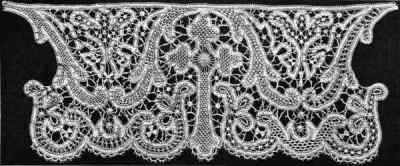
No. 33.—Altar Lace (Battenburg.)
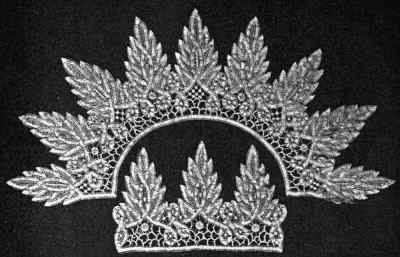
34Battenburg or Point Lace Collar and Cuff
These engravings represent a very graceful design for a lace collar and cuffs. As suggested in the title, the set may be made of point or Battenburg braid. The leaf-points are all filled in with d’Alençon bars in the twisted stitch, while the centers are completed with rosettes or small open “spiders,” and the latter are distributed elsewhere as will be seen by inspecting the engraving. Point de Grecque is also introduced into some of the spaces, and Raleigh bars are used for the ground-work. Any of the stitches previously described may be used in making such a collar if those mentioned are not admired; and the addition of buttons or rings will improve the work greatly.
No. 34.—Battenburg or Point Lace Collar and Cuff.
35Flounce in Battenburg Lace
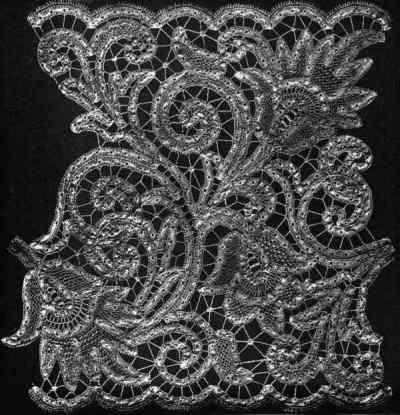
A very elegant flounce of Battenburg lace may be made after the design represented on the opposite page. The picture shows the flounce just one-half its actual width; but even this width would be very handsome as a band for the bottom of a dress. By a close inspection of the stitches seen and a reference to these illustrated in the department devoted to stitches, the various kinds here used may be easily identified. They consist of point de Venise, point de Bruxelles, Sorrento and d’Alençon bars and “spiders.” A fine picot braid edges each side of the flounce. The design can be obtained in any width desired from a reliable lace-maker.
No. 35.—Flounce in Battenburg Lace (One-Half the Actual Width).
36Butterfly Design for Point Lace
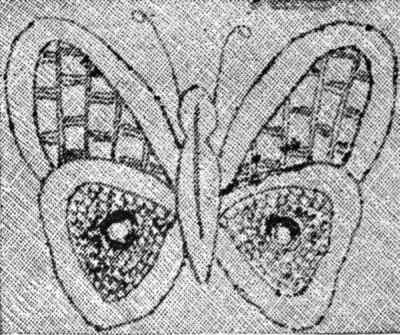
This design is for point lace braid, and is very easily made. Fancy bars made after an adaptation from the d’Alençon bars, and point de Venise stitches are used for filling in. The butterfly may be used as a portion of an edging design, or as a corner or center for any small article to be decorated. The lines extending from the head are made with a fine over-and-over stitch, or a fine cord.
No. 36.—Butterfly Design for Point Lace.
37Venetian Point Lace
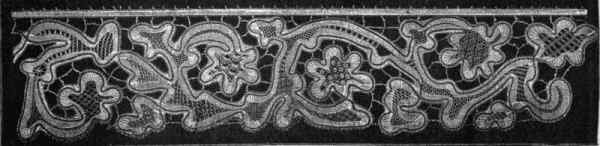
This is a design containing many of the features of antique lace patterns, and is made of narrow tape and fine cord combined with fancy stitches. The lace from which the engraving is made is about twice as wide as the picture represents it, but as the pattern differs in its sections for several inches at a time, the design could not be given full size. It will be seen that in the section illustrated no two figures are alike. The filling-in stitches consist of combinations and groupings of many of the stitches previously illustrated and described.
No. 37.—Venetian Point Lace.
38Butterfly Design for Fine Battenburg Lace
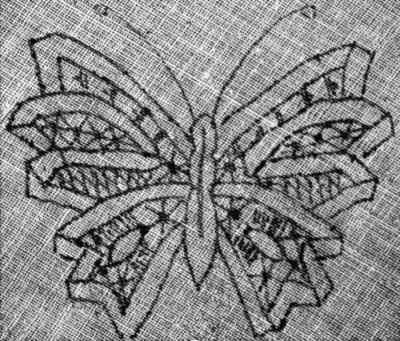
This design, developed in Battenburg lace with d’Alençon and Sorrento bars and small “spiders” or dots, makes a pretty ornament for centers or corners, or is effective when introduced as a part of an edging design. Point or Honiton braids may also be made up by this design.
No. 38.—Butterfly Design for fine Battenburg Lace.
39Design for Insertion
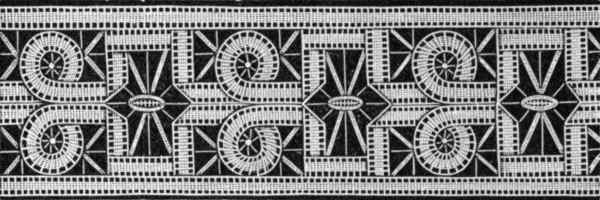
A very pretty design for insertion is here given. The braid may be basted as seen in the picture, and then the bars may be made of single threads, and of single threads over-wrought with button-hole stitches. Or, any of the bars or other stitches described, may be used to connect the braid and fill in the spaces. Tiny “spiders” are already used to fill in the circles.
No. 39.—Design for Insertion.
40Design for a Lace Border and Corner
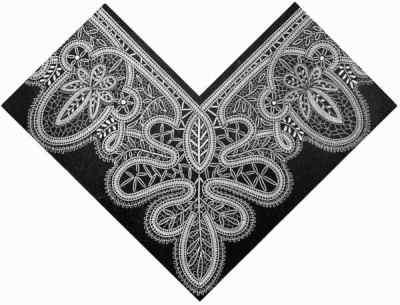
A great deal must be left to the ingenuity of the worker in filling in this design, which is not of the orthodox modern variety but may be readily transformed into that class by an adaptation of modern stitches. With the methods of the latter well mastered, the worker will have no trouble in bringing out the design just as it is illustrated; but she may also by the exercise of a little judgment and taste substitute many other pretty filling-in stitches for those here pictured.
No. 40.—Design for a Lace Border and Corner.
41Design for a Butterfly in Point Lace
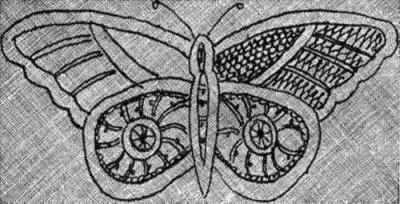
Another butterfly design is here given for point lace, though it may also be developed in a larger size in Battenburg braid for decorative purposes. The filling-in stitches are d’Alençon and Raleigh bars, point de Venise and point de Bruxelles, and point d’Angleterre rosettes.
No. 41.—Design for a Butterfly in Point Lace.
42Italian Lace
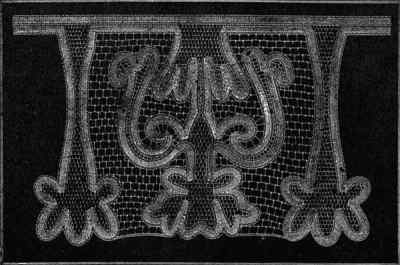
This lace is of a conventional Italian pattern, and is filled in with the Italian lace and ground-stitches, and Sorrento bars. The lower edge is very daintily completed with a button-hole effect. The design is simple, elegant, and popular, and may be wrought in Battenburg or the finer braids, and in any width desired, the braid selected and the width decided upon determining the use to which the lace shall be put.
No. 42.—Italian Lace (Half Size).
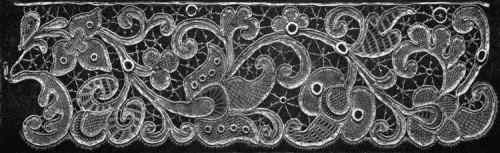
43Modern Venetian Point
The engraving shows a reduced representation of a very elegant specimen of modern lace—the reduction in size being necessary in order to present the whole design. In making the lace, narrow braid and cord are used for the foundation of the design, and then the filling-in stitches are made and at the same time rings and buttons and bars and picots are introduced. Some of the filling-in stitches are combinations—as in the figures with very open bars where point d’Espagne and point Brabançon are combined, and at the middle section of the central figure where point de Valenciennes and point Brabançon are combined. Other stitches used are d’Alençon bars, Raleigh bars, church stitch, point de Bruxelles, “spiders,” Sorrento bars, and picots. The greater the variety in the filling-in stitches, the more beautiful the lace. A picot edge finishes the lace in a very dainty manner along its lower outline, while a cord forms the upper edge.
No. 43.—Modern Venetian Point.
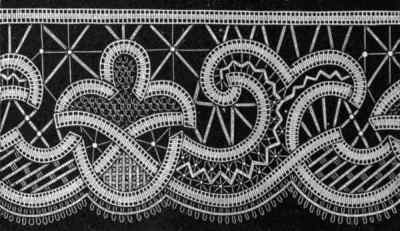
44Design for Modern Lace
This design may be made up in Battenburg braid, or of point or Honiton braid according to the texture of the lace desired. In making it for garments or articles that are to be renovated occasionally, the Battenburg braids are advisable; but for daintier uses, point or Honiton may be chosen. The Raleigh-bar stitch, point de Bruxelles, and “spiders” may be used in following the outlines given for stitches.
No. 44.—Design for Modern Lace.
Reprinted from The Art of Modern Lace-Making (The Butterick Publishing Co., 1891). Free for personal use. Please share a link rather than copying this page.