Chapter 6
Designs in Modern Lace, Part 2
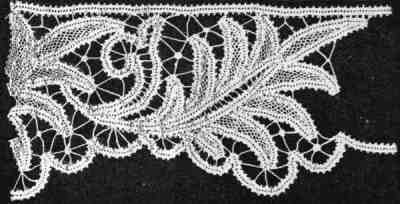
11Battenburg Edging
The edging here illustrated is represented about one-third less than its actual width, but the design is so distinctly brought out that its beauty in any width may be readily conceived. It is formed of fancy Battenburg braid, but may be made from a plain variety if preferred. The design is known as the fern leaf and is easy to follow. Sorrento bars are used to connect the work, and “spiders” are made here and there to add variety to the work. Point de Bruxelles stitches are used to fill in the spaces at the sides of the leaves, and, with the fancy braid, produce a very dainty, delicate effect.
No. 11.—Battenburg Edging.
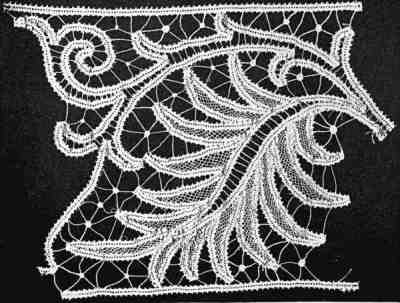
12Battenburg Insertion
This insertion is made to match the edging seen above it, but is much wider than the edging, though formed of the same braid. Either design could be varied so as to result in an edging and insertion of equal width, or the edging could be arranged for an insertion, and the insertion illustrated changed into an edging.
No. 12.—Battenburg Insertion.
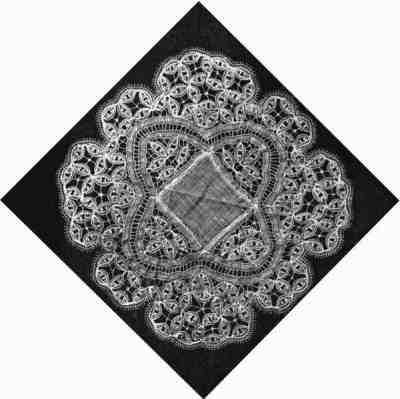
13Finger-bowl Doily of Princess Lace and Linen Lawn
Princess lace, (also known as Duchesse lace) as elsewhere mentioned, results from combining Honiton and point lace braids in one design; and a charming specimen of this lovely lace is here illustrated.
The doily is pictured only a trifle smaller than its actual size, and even in its full size is a very dainty affair. After the braids are basted along the design, they are then connected by twisted bars that are an adaptation from the point d’Alençon bars with the twisted stitch; and the spaces are filled in in small d’Angleterre rosettes or “spiders.” As few bars as possible are employed for the spiders, in order to produce a very delicate effect. The lawn center is added last.
No. 13.—Finger-Bowl Doily of Princess Lace and Linen Lawn.
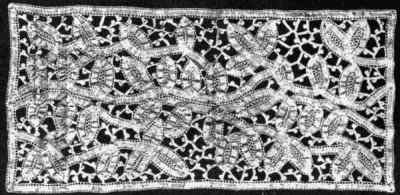
14Design for Insertion, or a Center-piece, in Battenburg Lace
As suggested by the title, the design here presented may be used for insertion, or for a center to a table cloth or scarf, or a handsome spread. As represented it is intended for a center-piece, and the lace from which the engraving was made is about half-a-yard long and one-fourth of a yard wide. The ground-work is formed of Raleigh bars made with picots, and the loops of braid are filled in with twisted point d’Alençon bars.
This center-piece is very pretty made of ribbon with silk thread for the bars, and in this event it may be made of any color desired, and added to a spread or scarf of Surah silk or fine cloth, for which a border to match may be made.
No. 14.—Design for Insertion, or a Center-piece, in Battenburg Lace.
15Queen Anne Tray-cloth of Battenburg Lace and Linen
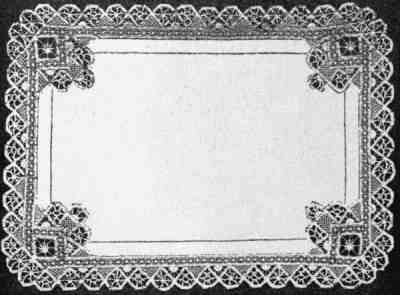
This pretty cloth is intended for a Queen Anne tray, and its lace edges curve upward and just over the rim of the tray when it is laid upon it. The center is of fine table-linen, while the edge is formed of Battenburg braid, buttons and fancy stitches. As will be seen, the corner spaces are filled in with point d’Angleterre rosettes or “spiders,” the large border spaces and corresponding corner ones are filled in with picot bars, while the very fine work seen in the triangles and square spaces are point de Venise stitches, and half-spiders are made in the other triangles. The narrow, straight inner border is composed of bars and tiny buttons arranged as represented. The cloth is hem-stitched before the braid is laid on, and the corners are cut out from underneath after the work is otherwise completed.
No. 15.—Queen Anne Tray-Cloth of Battenburg Lace and Linen.
16Design for a Butterfly in Point Lace. (full Size)
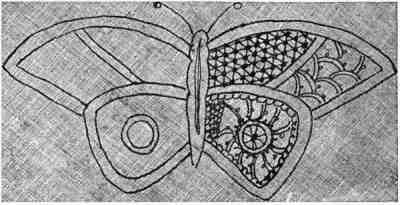
Butterflies for the corners of handkerchiefs, scarf-ends and the points of caps or coiffures are favorite designs in point and Honiton laces. The one illustrated is very dainty and exceedingly simple to execute. The upper portion of each wing has a point de reprise ground-work, but the solid sections are tiny spiders instead of point de reprise triangles. The outer tips of the wings are filled in with Raleigh bars, while similar bars, point de Bruxelles stitches and a point d’Angleterre rosette complete the lower wings. Any of the fine point or Honiton braids may be chosen for the outlining of the butterfly, and a fine over-and-over stitch or fine cord may be used to mark the lines extending from the head.
No. 16.—Design for a Butterfly in Point Lace. (Full Size).
17Design for a Doily or Handkerchief of Point or Honiton Lace
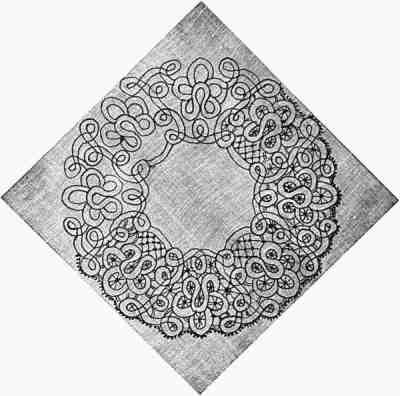
This design, as illustrated, is of course too small for either a doily or handkerchief, but an expert lace-maker can enlarge it to any size desired; and the clever amateur will find no difficulty in doing the same thing, as the outlines are not at all intricate, and may be easily followed. In sending for the braid for this, or similar designs, it is advisable to permit the lace-maker addressed to select them, and of course, the thread, since her long experience enables her at once to correctly judge what materials are appropriate for the articles you wish to make, especially if she knows the size the article is desired to be. The stitches, as here indicated, are point d’Angleterre rosettes, and point de fillet, with small “spiders” on the latter. A dainty picot-braid edges the design.
No. 17.—Design for a Doily or Handkerchief of Point or Honiton Lace. (Half Size.)
18“cardinal’s Point” Lace
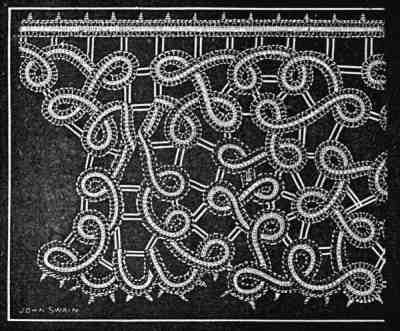
This engraving represents a modern adaptation of an ancient lace which may be made of fancy Battenburg braid and plain Raleigh bars. The design is not especially definite in its outlines, and may be imitated with any variations which may seem pleasing to the copyist. The picots are made after the method directed at the illustration of point de Venise bars in the department devoted to stitches. “Cardinal’s point” of genuine make is of Italian origin, and in the earlier eras, was largely used for the decoration of church vestments and draperies.
No. 18.—”Cardinal’s Point” Lace.
Nos. 19 and 20. Battenburg Edging and Insertion, with Cord
These two engravings show a very pretty design for Battenburg lace made with a cord finish. The application of the cord has been fully described elsewhere, where a different design of the same kind of work is given. In the present instance the spaces are filled in with twisted bars, “spiders” and rosettes in point d’Angleterre. The specimens from which the engravings were made are a trifle wider than seen in the pictures; but the width is a matter of individual taste, and also a result of the braid selected. A professional lace-maker will enlarge or adapt the design to accord with personal requirements.
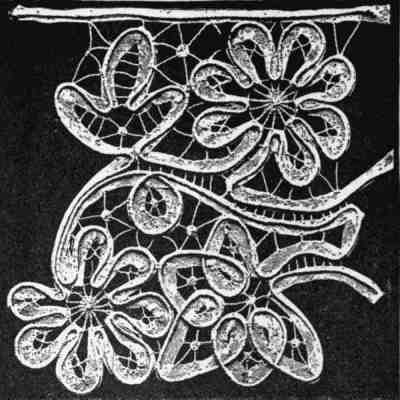
No. 19.—Battenburg Edging, with Cord.
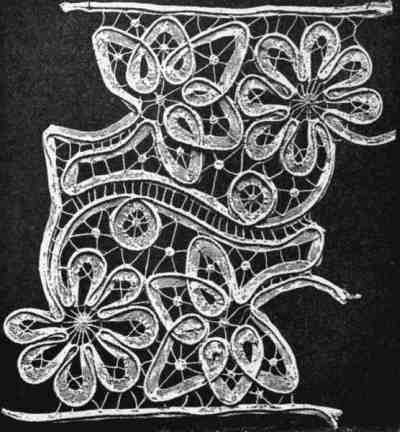
No. 20.—Battenburg Insertion, with Cord.
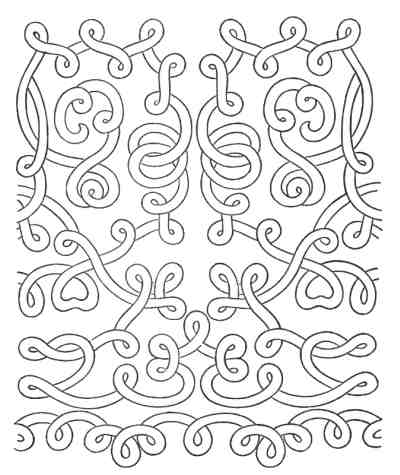
21Tape-guipure Design, Found in an Old Church
The design here illustrated was found in the old church of Santa Margherita, in Italy. It was drawn on parchment, and was undoubtedly intended as a design for altar lace. It was mentioned in a book of accounts for the year 1592, found in the archives of the church designated and is therefore of antique origin; but it may be easily adapted to modern methods of lace-making, and could be appropriately filled in with either Italian or Genoa lace stitches or with a combination of both, and twisted bars. Done with fancy Battenburg braid, it would be quite similar in effect to the “Cardinal’s Point” illustrated on another page.
No. 21.—Tape-Guipure Design, found in an Old Church.
22Battenburg Church Lace
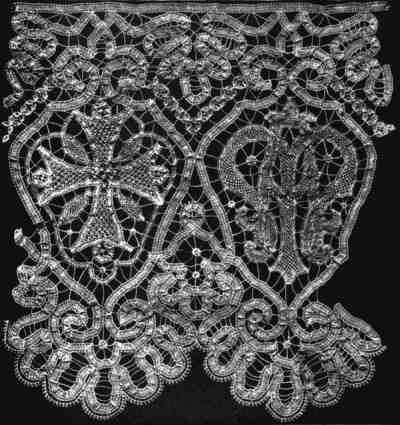
The engraving opposite illustrates a magnificent specimen of Modern Church Lace made of Battenburg braid with a limited introduction of Honiton braid. The specimen itself is considerably wider than represented, but as the width is a matter of individual taste, the engraving will serve as a design for a narrow church lace.
Sorrento bars are used to connect the braids and to form foundations for the spiders or rosettes here and there inserted, and the lace is delicately bordered with a dainty picot-braid. The fancy stitches in the main portions of the cross are point de Valenciennes, while those in the minor sections are point de Bruxelles.
Point de fillet is used for the central portion of the large T-shaped symbol, while the stitch forming the other symbol is one never used except for church lace, and consists of two or three sets of fine stitches so interlaced as to seem to form one solid stitch.
In making church lace any insignia desired can be introduced by a professional designer—an accomplishment that is usually beyond the inventive powers of the novice in lace-making.
No. 22.—Battenburg Church Lace.
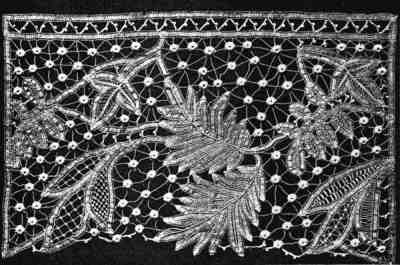
23English Needle-point
This is a very handsome design combining the lily and the rose. The foundation work is made with unbleached linen braid having an ornamental edge, and the filling-in is done with fine and coarse linen thread in various stitches. Raleigh bars with picots define the upper edge of the edging, and Sorrento bars on which buttons are worked form the ground work.
- Point de Grecque, point d’Angleterre, d’Alençon bars plain and twisted, point de Bruxelles and “spiders” are also used in making this lace, as will be seen from a close inspection of the engraving.
- This specimen of lace is very handsome when developed in black silk braids and silk thread, for black costumes.
- No. 23.—English Needle Point.
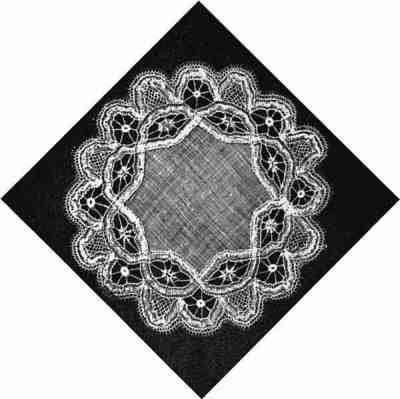
24Punch-glass Doily of Point Lace and Lawn
As represented this doily is about three-fourths of its actual size. It is made of fine linen lawn, and a set generally comprises a dozen. Fine point lace braid is used to outline the design, and then rosettes in point d’Angleterre, and “spiders” or small rosettes are made in the openings as represented. The alternate outer scallops are filled in with point de Bruxelles stitches, and a dainty picot-braid is added to the edge by the usual over-and-over stitch.
No. 24.—Punch-Glass Doily of Point Lace and Lawn.
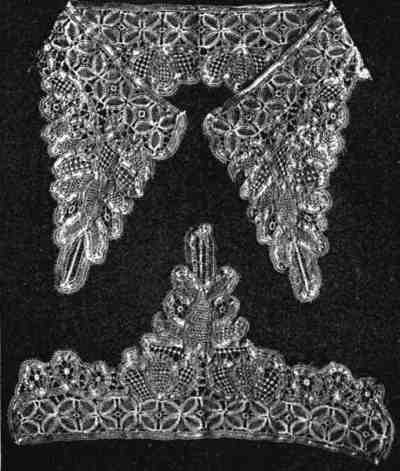
25Point Lace Collar and Cuff
A very handsome point lace set is here illustrated, and may be easily followed by an expert lace-maker; but it will be wiser for the novice to obtain a pattern or design of the shape and size desired, from a professional lace-maker. Point de Grecque, point de Bruxelles, point de Venise, Sorrento bars, and rosettes and rings are all employed in carrying out this design. As elsewhere mentioned, any fine stitch preferred may be used for filling-in purposes when those suggested or marked out upon a design are not admired.
No. 25.—Point Lace Collar and Cuff.
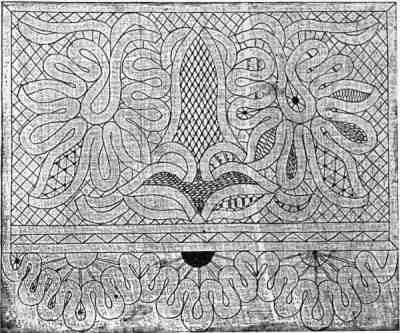
26Design for Table Scarf in Battenburg Lace
The scarf-end from which this design was copied is about ten inches deep, and it is about fourteen or fifteen inches wide. It will be seen from these dimensions, that it is impossible to produce a full-size design of it on these pages, but one of any size desired may be obtained at any lace-makers; or, a clever student of lace-making may enlarge the design to suit her own requirements. According to the size of the scarf-end, wide or narrow braid must be selected, with thread to correspond. The stitches used in filling in are point de fillet, point de Bruxelles and point d’Angleterre, and Raleigh, Sorrento and d’Alençon bars, and rosettes and “spiders.”
No. 26.—Design for a Table Scarf in Battenburg Lace.
Reprinted from The Art of Modern Lace-Making (The Butterick Publishing Co., 1891). Free for personal use. Please share a link rather than copying this page.